Semiconductor Climate Engine
A semiconductor plate and controlled airflow deliver heating and cooling—without separate mats, lamps or controllers.

XDen rebuilds temperature, humidity, light and daily rhythm as one coordinated habitat system—a piece of the wild, returned indoors.

Kickstarter launch alerts & early-bird access. No noise.
From equipment to environment
Traditional reptile keeping asks you to assemble a habitat from thermostats, heat mats, lamps, timers, sensors and cables—then make every device agree.
XDen replaces the collection of objects with one climate system—built to coordinate the environment, not just switch devices on and off.

The XDen technology system
Each pillar removes a separate piece of equipment or uncertainty. Together, they let XDen behave as one coordinated climate system.
A semiconductor plate and controlled airflow deliver heating and cooling—without separate mats, lamps or controllers.

Four Natural Models coordinate temperature, humidity and light. Custom keeps manual control.

Two UVB optics — 60° focus, 120° flood — work alongside 365nm UVA, 410nm plant light, and dual-white full-spectrum daylight.

A removable 2L reservoir, condensation return and isolated waterways keep moisture controlled and critical electronics protected.

See the animal and its environment together in one remote view.
Nature, translated into code
A reptile experiences changing air, moisture, light and time—not isolated readings. XDen’s semiconductor climate engine coordinates heating and cooling through controlled airflow, then connects humidity, lighting and daily rhythm as one system.

A semiconductor plate changes temperature while controlled airflow distributes heating and cooling through the habitat.
The integrated 2L water system supports humidity routines, while collected condensation returns to the reservoir.
Day, night, environment and lighting operate as a connected rhythm rather than isolated timers.
Temperature, humidity and climate-model status remain together on the product interface.
Real climates, modelled
Each model loads temperature, humidity, UVB, UVA, plant light and daylight color as one coordinated environment.
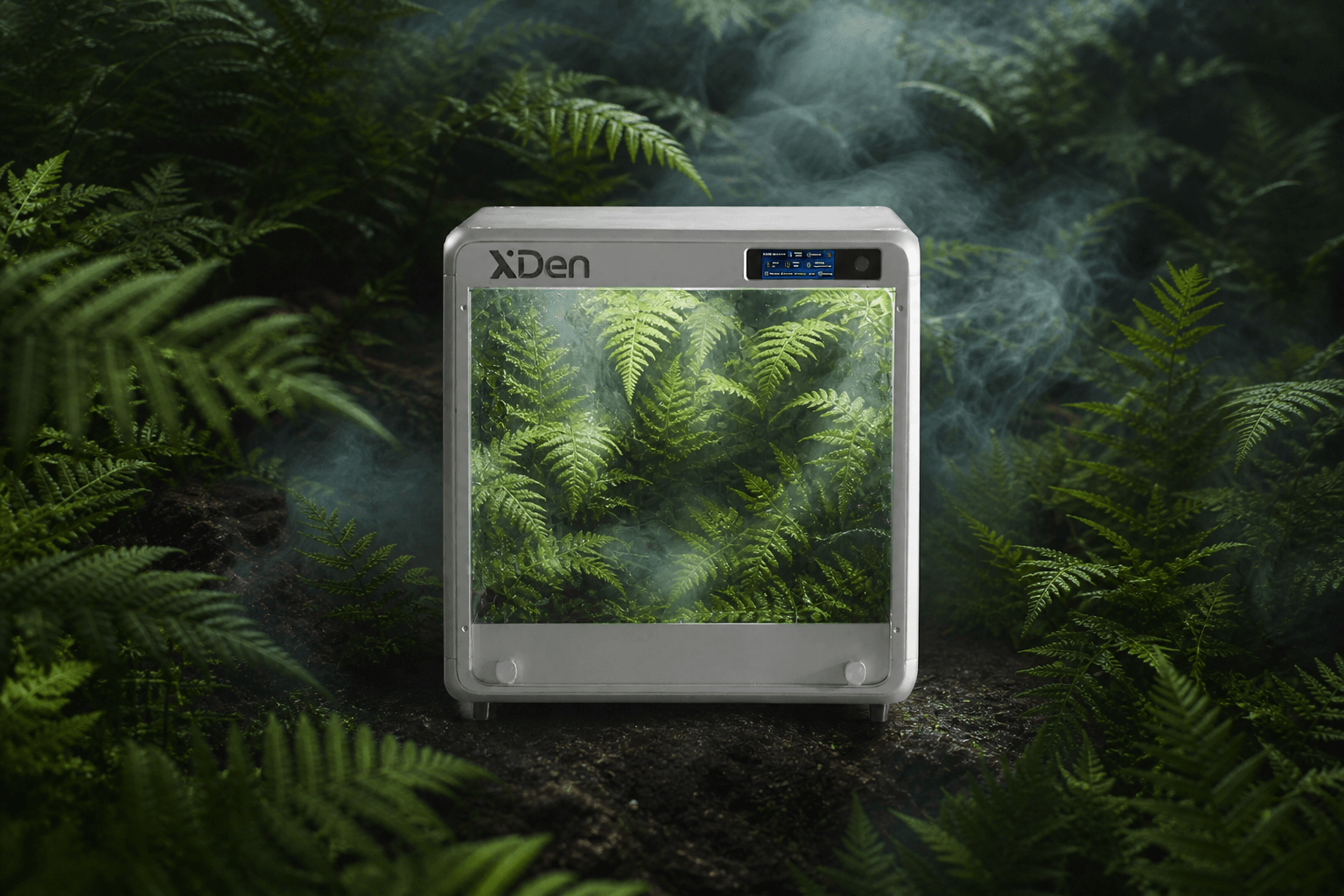
Tropical Rainforest
Amazon to Congo. Dart frogs, emerald tree boas and day geckos. Hot and wet—mist never leaves the leaves.
Light, calibrated as dose
XDen treats light as a calibrated dose, not a fixture placed by guesswork. Dual UVB optics, UVA, plant light and Ferguson Zone logic work as one system.
Two optical characters in one system.
Controlled, concentrated beam.
Gentle background exposure.
Behavioral trigger, timed in synergy with UVB.
Bioactive spectrum for live plants.
Automated exposure based on the selected zone.
Maintenance, engineered out
From substrate changes to water refills and condensation return, routine care stays simple and contained.

Bring the living area toward you for direct access—without reaching through the whole enclosure or dismantling the habitat.

Routine adjustments happen at the front edge of the habitat, keeping daily care simple and the enclosure easy to close securely.

Remove the side reservoir, top it up and return it to XDen while the reptile and interior setup stay undisturbed.
Active protection, built in
XDen is designed to respond to low water, excess heat and abnormal system behavior—then fall back toward a safer operating state.

Responds when the water level runs low.
Reduces output before heat becomes unsafe.
Falls back to a safer state when a system is abnormal.
keeps moisture handling physically separated from critical electronics
A camera inside the climate
See the animal and the environment together. Check the habitat, review current conditions and stay connected through the XDen app.

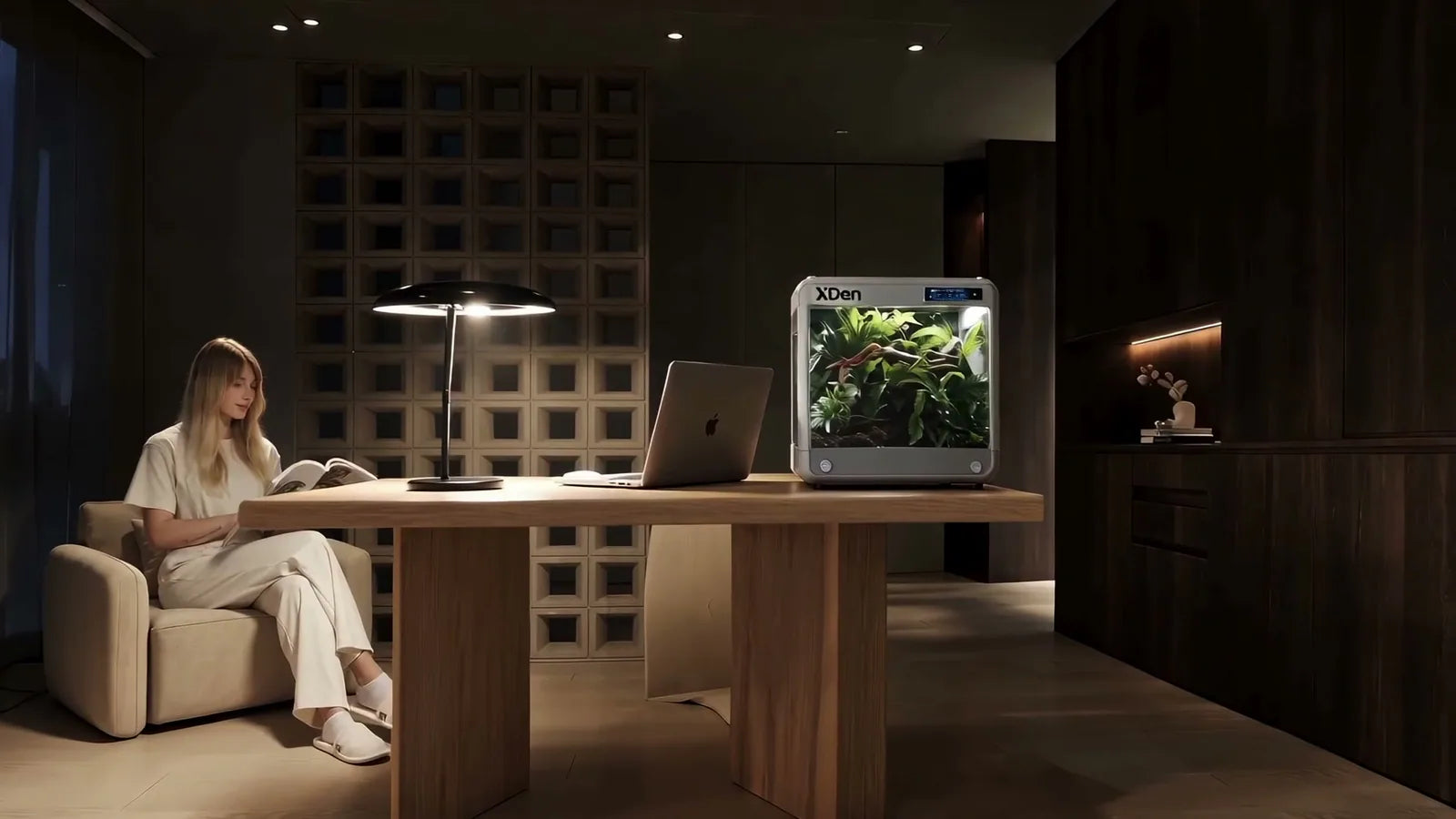
Designed for modern homes
Place XDen in the dining area, bedroom or home office. When your collection grows, add another habitat vertically instead of spreading equipment across the room.


Objects versus a climate system
The clean exterior is only the visible change. Underneath, XDen replaces device-by-device control with coordinated climate, light and care systems.
XDen coordinates heating and cooling through controlled airflow, then connects humidity, lighting and daily rhythm in one system. It is designed to maintain a species-appropriate climate and gradient with less manual adjustment—not to make every part of the habitat the same temperature.
No. Four fixed Natural Models—Rainforest, Desert Rockland, Cloud Forest and a 90-day Wet-Dry Cycle—load coordinated environmental conditions with one tap. They simplify setup, but they do not replace species research or professional care advice.
The 2L water system reduces frequent refills, while the pull-out habitat drawer, removable reservoir and separated moisture architecture make cleaning and water care easier. Refill and cleaning frequency will still depend on the habitat and how it is used.